.png)
.png)


How to Choose Between a Semi-Automatic and Fully Automatic Defibrillator

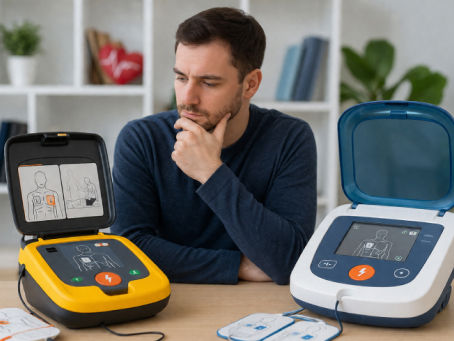
Choosing between a semi-automatic AED device and a fully automatic defibrillator depends on the user’s confidence level, training, and the environment where the device will be used. A semi-automatic defibrillator requires the user to press a button to deliver a shock after the device analyzes the heart rhythm, while a fully automatic defibrillator delivers the shock on its own without user intervention. For trained responders or workplaces with basic first aid knowledge, a semi-automatic defibrillator offers more control. In contrast, for public spaces or untrained users, a fully automatic automated external defibrillator is often the safer and more user-friendly option.
Understanding this difference is the key to making the right decision and ensuring faster, more effective emergency response when every second matters.
Understanding What an Automated External Defibrillator Does
An automated external defibrillator (AED) is a life-saving device designed to treat sudden cardiac arrest (SCA). It works by analyzing the heart’s rhythm and delivering an electric shock if needed to restore a normal heartbeat.
In emergencies, timing is critical. Without defibrillation, survival chances decrease by up to 10% with every passing minute. That’s why having the right AED and knowing how it works is essential.
When exploring options through Edwin O'Sullivan Training Solutions, you’ll find AEDs designed for both trained professionals and everyday users, making it easier to match the device to your environment.
What Is a Semi-Automatic AED Device?
A semi-automatic AED device analyzes the patient’s heart rhythm and instructs the user when a shock is needed. However, it requires the rescuer to press a button to deliver the shock.
Key Features:
Voice and visual prompts guide the user step by step
Shock is delivered only when the user presses the button
Provides a sense of control during emergency situations
Commonly used in workplaces, schools, and by trained responders
Benefits:
A semi-automatic defibrillator is ideal for environments where staff have some level of first aid or CPR training. The manual confirmation step ensures the rescuer is ready and that the scene is safe before delivering the shock.
Additionally, this type of AED is often preferred in professional settings because it reinforces situational awareness, something emphasized in every AED safety guide.
What Is a Fully Automatic Defibrillator?
A fully automatic AED performs the same analysis as a semi-automatic device, but once it determines a shock is necessary, it delivers it automatically without requiring the user to press a button.
Key Features:
Fully hands-free shock delivery
Simple and highly intuitive operation
Minimal user decision-making required
Designed for public and high-traffic areas
Benefits:
A fully automatic external defibrillator is especially useful in locations where responders may not have medical training. It removes hesitation and reduces the chance of human error.
For example, in shopping centres, airports, or community spaces, people may panic or feel unsure. A fully automatic device ensures that the life-saving shock is delivered without delay.
Semi-Automatic vs Fully Automatic: Key
Differences
Understanding the practical differences helps you make a confident choice:
1. User Control
Semi-automatic AED device: Requires user to press shock button
Fully automatic AED: Delivers shock automatically
2. Ease of Use
Semi-automatic: Slightly more involvement
Fully automatic: Simplest option for untrained users
3. Safety Considerations
Semi-automatic: User ensures no one is touching the patient before shock
Fully automatic: Device warns before delivering shock
4. Best Use Environment
Semi-automatic: Workplaces, healthcare settings, trained teams
Fully automatic: Public spaces, schools, community areas
Which AED Is Better for You?
There’s no one-size-fits-all answer; it depends on your specific needs.
Choose a semi-automatic defibrillator if:
Your team has CPR or first aid training
You want more control during emergencies
You operate in a workplace or controlled environment
You follow structured emergency response protocols
A semi-automatic defibrillator Ireland solution is commonly chosen by businesses that invest in staff training and want to maintain hands-on control during critical situations.
Choose a Fully Automatic Defibrillator If:
The device will be used by the general public
Users may have no prior training
You want the fastest possible response with minimal hesitation
The AED is placed in high-traffic or community areas
In these scenarios, simplicity saves lives. A fully automatic external defibrillator ensures immediate action without second-guessing.
Why Training Still Matters
Even though AEDs are designed to be user-friendly, proper training significantly improves outcomes. Knowing how to respond calmly, position pads correctly, and follow prompts efficiently can make a life-saving difference.
Edwin O'Sullivan Training Solutions not only provides high-quality AED devices but also offers training programs that help individuals and organizations build confidence in emergency situations.
Whether you choose a semi-automatic AED device or a fully automatic one, pairing it with training ensures maximum effectiveness.
Placement and Accessibility Tips
Choosing the right AED type is only part of the equation. Proper placement is equally important.
Best Practices:
Install AEDs in clearly visible and accessible locations
Use signage to guide people quickly
Ensure regular maintenance and battery checks
Keep devices close to high-risk or high-traffic areas
Following an AED safety guide ensures your device is always ready when needed.
Cost Considerations
While both types of AEDs are similar in price, the decision shouldn’t be based on cost alone.
Instead, consider:
Who will use the device
How quickly it needs to be deployed
The level of training available
The environment and risk level
Investing in the right AED from Edwin O'Sullivan Training Solutions ensures long-term value, safety, and peace of mind.
Summary
In conclusion, the choice between a semi-automatic AED device and a fully automatic defibrillator depends on user experience and the setting. Semi-automatic devices offer more control for trained users, while fully automatic AEDs provide simplicity for untrained responders. The key is selecting a device that can be used quickly and confidently to save lives in an emergency.
Frequently Asked Questions
Q1. What does an automated external defibrillator (AED) do?
An automated external defibrillator (AED) analyzes the heart’s rhythm and delivers a shock if needed to restore a normal heartbeat during sudden cardiac arrest.
Q2. Is a semi-automatic AED device difficult to use?
No, a semi-automatic AED device is designed to be user-friendly. It provides clear voice and visual instructions, guiding the user step by step.
Q3. Can an untrained person use a fully automatic defibrillator?
Yes, a fully automatic defibrillator is ideal for untrained users because it delivers the shock automatically after giving clear warnings and instructions.
Q4. Which is safer: semi-automatic or fully automatic AED?
Both are equally safe. They only deliver a shock if it is medically required, ensuring patient safety at all times.


